
The short answer
SEO can bring a UK recruitment agency visitors, but no independent return figure was found, and Google says no one can guarantee a number one ranking. The site serves hirers and candidates, who need different pages and different proof. Count hirer enquiries from the hirer pages over eight weeks against a stop line set beforehand, and treat candidate clicks as a separate result.
Key takeaways
- Google's guide to hiring an SEO says no one can guarantee a number one ranking.
- Google's starter guide says changes take from a few hours to several months and suggests waiting a few weeks before judging one.
- Job pages carry their own Google rules, including expiring filled vacancies, so a supplier should say how that is handled.
- Search Console groups clicks by page, which lets an agency split hirer pages from vacancy pages.
- The worksheet figures here are invented. They show how to read a count and describe no real agency.
Two ranking guides to SEO for recruitment agencies were opened for this piece. One lists statistics about job seekers and recruiters, credited to other companies' pages, and gives no result from an agency. The other is dated 2017, runs to about 350 words and carries no figures at all. Both are published by companies that sell to recruiters, which is a fair reason to ask whether SEO works before paying for it. Google's own documentation says little about timing and nothing about the return to a recruitment agency. What it does say is specific enough to build a test from, and a test is better than a promise.
What can honestly be said about whether it works
No independent figure for the return on SEO to a UK recruitment agency was found, so any percentage quoted for it is the seller's. That is a statement about what was found for this piece, not proof that the return is nil. Google's guide to whether you need an SEO says no one can guarantee a number one ranking on Google and warns against SEOs who claim to guarantee rankings. It suggests asking a prospective supplier what results it expects and in what timeframe.
On timing, the SEO starter guide says some changes might take effect in a few hours and others could take several months. It suggests waiting a few weeks before deciding whether a change helped. That dates a change. It does not date a campaign, so a recruitment agency has to measure its own.
Two audiences need two different tests
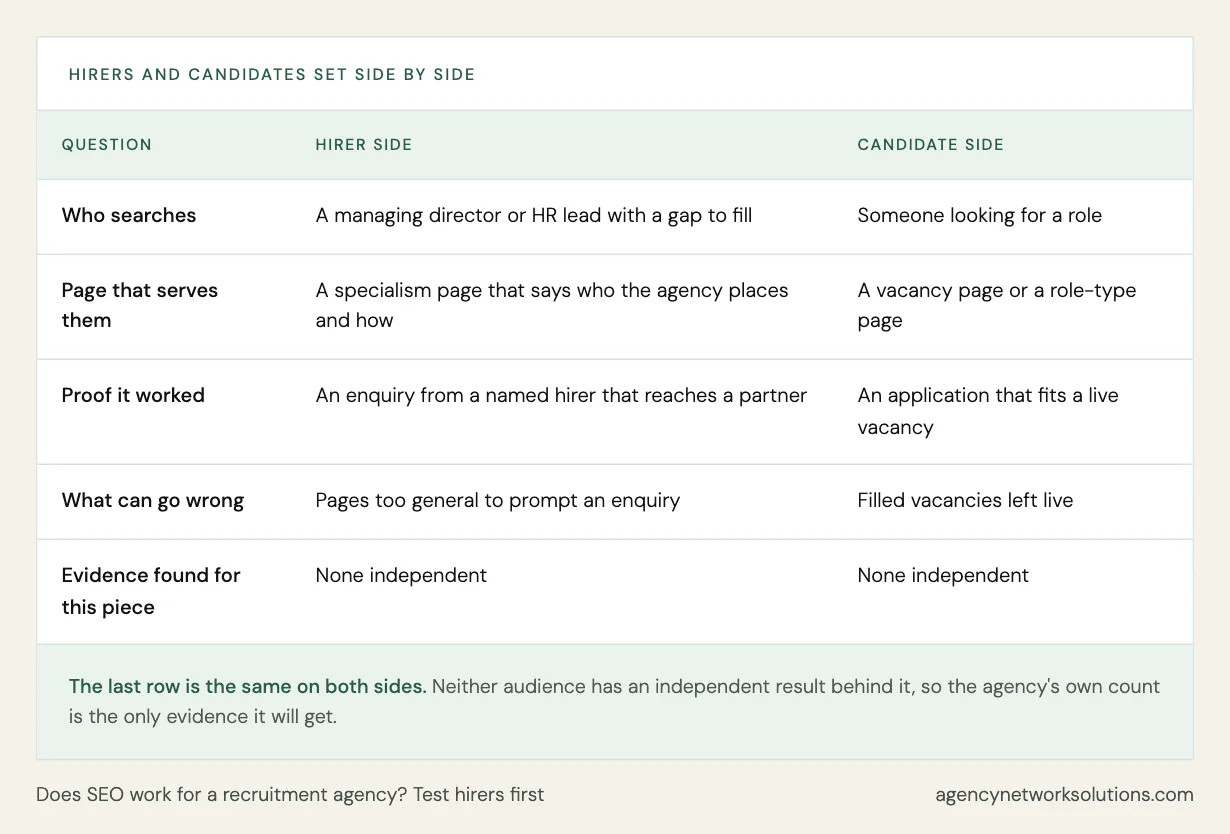
A recruitment agency's site is read by hirers and by candidates, and only one of them pays the fee. The rival guides treat the two as one audience with one set of keywords. They are better split, because the page and the proof differ.
| Question | Hirer side | Candidate side |
|---|---|---|
| Who searches | A managing director or HR lead with a gap to fill | Someone looking for a role |
| Page that serves them | A specialism page that says who the agency places and how | A vacancy page or a role-type page |
| Proof it worked | An enquiry from a named hirer that reaches a partner | An application that fits a live vacancy |
| What can go wrong | Pages too general to prompt an enquiry | Filled vacancies left live |
| Evidence found for this piece | None independent | None independent |
Read the proof row. A candidate application can be real, and the agency can still be unable to place the person, since the fee comes from a hirer. Our article on how recruitment agencies get clients sets out the routes that begin with the hirer; search is one of them, and this article tests that one alone.
What a hirer page has to settle first
A hirer page works only if a managing director can tell within a few lines whether the agency places the roles they need. That means one specialism per page and the kinds of vacancy it fills, stated in the words a hirer would use. A UK agency that places finance staff and warehouse staff on one general page gives a hirer in either field a reason to keep looking. Six narrow pages, as in the worksheet below, give each reader a page that is plainly theirs.
The page should also say what happens after an enquiry: who reads it and how soon a partner replies. None of this is a ranking tactic. It decides whether a visitor who arrives from search turns into a logged enquiry, and the count further down measures exactly that.
The Google rules that apply to the candidate side
Google's job posting documentation says that failure to take timely action on expired jobs may result in a manual action. A vacancy page can carry structured data so that Google can read the job, and the job posting page attaches conditions to it. A filled role must be expired, which Google says can be done by giving a past date in the validity field or by removing the page.
Two further points matter to an agency specifically. When an employer is hiring anonymously, for example through a staffing agency, the documentation says to set the hiring organisation's name to confidential. The page also names job postings on behalf of an organisation without authorisation among its violations. A quote for a recruitment site should say who expires filled vacancies and how the agency records a hirer's authority to advertise.
None of this concerns the hirer pages, which is why a site can do well on vacancies and still win no clients. A supplier can be paid for activity that was not the result, a point covered in our article on what you can hold an agency to when results do not come.
Read a Search Console export by page group
Search Console's performance report groups its click data by page on the Pages tab. Google's performance report help defines clicks as the times a user clicked the site from Google Search results, impressions as the times the site appeared, and click-through rate as clicks divided by impressions. Export the Pages tab and sort the pages into two groups, then add the enquiries logged from each group over the same eight weeks.
| Page group | Impressions | Clicks | Click-through rate | Hirer enquiries |
|---|---|---|---|---|
| Hirer pages (six specialism pages) | 1,800 | 45 | 2.5% | 3 |
| Vacancy pages | 14,000 | 420 | 3.0% | 0 |
The arithmetic: 45 clicks from 1,800 impressions is 2.5%, and 420 from 14,000 is 3.0%. Together that is 465 clicks, of which the hirer pages took 45, just under 10%. A report of rising traffic would have hidden that, since nearly all of it arrived on pages that produce no fee. Three enquiries from 45 hirer clicks is about 7 in every 100.
Now the stop line. Before the first export, the agency writes down what would make it stop, for example fewer than two hirer enquiries in eight weeks. Three clears that line, so the agency keeps going and repeats the count for a second period before spending more. Had it been one, the next move would be to rewrite the hirer pages or to try a different route, not to buy more traffic.
What a monthly report should show is covered in our article on what a marketing agency should report every month. The page-group split belongs in it.
A routine for the eight weeks
The count needs a set-up week and two dated exports, and one person can do each in under an hour. In the first week, list the hirer pages and the vacancy pages, then write the stop line down. At the end of week four, export the Pages tab for the period and log the hirer enquiries that arrived, with the page each started on where the enquiry form records it. At the end of week eight, repeat the export and apply the stop line.
Google's starter guide suggests waiting a few weeks before judging a change, so the week-four reading is a check on the record-keeping and not a verdict. If the enquiry log has no column for the page, add one before anything else. Without it the eight-week count falls back to guesswork, which is the position the agency was trying to leave.
What to ask a supplier who promises results
Ask for the result the supplier expects and its date, and for the page group it counts. Google's guide suggests the first two questions itself. The third stops a report of vacancy clicks being presented as hirer demand. Ask also who expires a filled vacancy and whether the quote includes it, since that task recurs every week and is the part of the work most easily dropped.
A supplier that answers with a ranking rather than an enquiry count has changed the question. A page one position for a general phrase might be real and still bring no hirer, and the count above is the only way to see it.
When the test is set
Want a specialist who reports hirer enquiries, not traffic?
Free to your firm. The agency pays us, and only if the relationship works, so we gain nothing by recommending one who cannot show you the count. What we look at for recruitment agencies is on the recruitment agencies page.
Get a recommendationWhen not to start SEO yet
Wait if the agency cannot yet name the specialism its hirer pages are for. General pages produce general enquiries, if any, and the count cannot tell a weak page from a weak market. Wait too if no partner will read the export every month, or if the agency needs hirers this quarter, because Google's own timing guidance makes search a slow way to fill a gap. In that case outreach comes first, and the hirer pages can be written while it runs.
Frequently asked questions
What UK recruitment agencies ask about SEO.
Does SEO work for a recruitment agency in the UK?
It can bring visitors, but no independent figure for the return to a recruitment agency was found for this piece, and Google says no one can guarantee a number one ranking. The honest test is a count of hirer enquiries from the pages written for hirers over a fixed period, set against a stop line chosen in advance.
How long does SEO take to work for a recruitment agency?
Google's SEO starter guide says some changes take effect in a few hours and others could take several months, and suggests waiting a few weeks before judging whether a change helped. It gives no figure for a campaign, so a UK agency should ask any supplier for a dated expectation it can hold them to.
Should a recruitment agency optimise for candidates or for hirers?
Both audiences use the same site but pay the agency differently. Candidate pages tend to collect more clicks, while a hirer enquiry is what the fee depends on. Count the two separately before deciding where the effort goes.
Do job adverts on a recruitment agency's website help SEO?
A vacancy page can carry job posting structured data that Google can read. Google's documentation says failure to take timely action on expired jobs may result in a manual action, so every filled vacancy needs expiring. Whether the adverts bring hirer enquiries is a separate question that the page-group count answers.
Can an SEO supplier guarantee a recruitment agency a first page ranking?
No. Google's guide to hiring an SEO says no one can guarantee a number one ranking and warns against SEOs who claim to guarantee rankings. A supplier can reasonably be asked what result it expects and by when.
Sources and useful reading
Four Google pages were opened and read on 9 November 2026 for this article. No independent return figure for recruitment SEO was found. Every figure in the worksheet is invented.
- Google Search Central: do you need an SEO?, for the statement that no one can guarantee a number one ranking and the questions to put to a supplier.
- Google Search Central: SEO starter guide, for how long changes take to show.
- Google Search Central: job posting structured data, for the rules on expired jobs and anonymous hiring.
- Search Console Help: performance report, for the performance report definitions.
This article is commercial decision support and is not legal advice. Google's documentation changes, so check the current page before relying on a rule. The page-group count and its figures are invented to show the method and describe no real agency.