
The short answer
A UK accountancy practice wins new clients through five routes: recommendation by existing clients, introductions from other professionals, its website and search, local events and direct outreach. No industry share is quoted here. The ICAEW and the ICO set a different limit on each route, so a practice should record the real route for every new client for a year before it adds spend.
Key takeaways
- The ICAEW marketing helpsheet, updated on 5 November 2025, says advertising material should be legal, decent, honest, truthful and clear, and that a firm stays responsible for marketing an agency carries out on its behalf.
- The same helpsheet says a firm may pay for the introduction of a client, but the payment threatens objectivity and the client should know of the arrangement.
- The ICO says sole traders and some partnerships are treated as individuals for marketing email, while companies and limited liability partnerships can be emailed.
- In February 2024 the ICAEW reported gaps in accounting for unregulated commission and referral fees at 51 of the firms reviewed.
- The matrix and the 24-client ledger are this article's own and the ledger is invented. No industry percentage, client or agency is named.
Ask a managing partner where the practice's new clients come from and the answer is usually one word: referrals. The word hides at least four different routes. A client who recommends the practice over dinner, a solicitor who introduces a probate client and is thanked with a fee, a prospect who was recommended and then searched the practice's name before ringing, and a stranger who replied to an email all end up under "referral" in a spreadsheet, if the source is recorded at all. Each runs under a different UK rule. This article quotes no industry percentage for the split, because a practice's own last twelve months are a better dataset than any survey. It sets five routes against the published ICAEW and ICO text, then recodes an invented 24-client year to show how much one word can hide.
Five routes, and the text that governs each
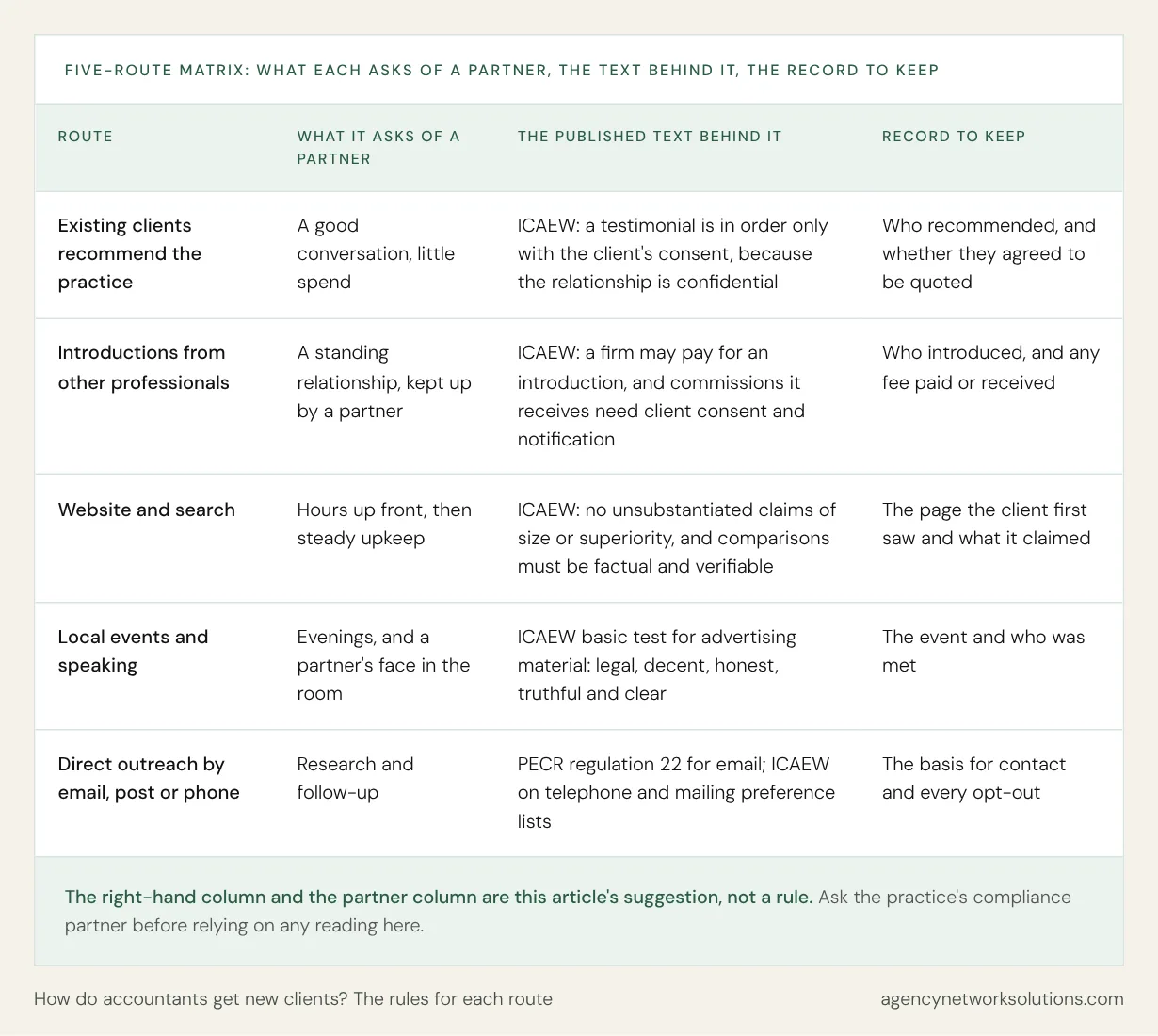
Every route a practice uses has a published limit, and the limits differ more than the routes do. The middle column of the matrix quotes or paraphrases the ICAEW's marketing helpsheet, first issued on 1 February 2015 and updated on 5 November 2025, and the ICO and legislation pages linked below. The other two columns are this article's reading and not a rule.
| Route | What it asks of a partner | The published text behind it | Record to keep |
|---|---|---|---|
| Existing clients recommend the practice | A good conversation, little spend | ICAEW: a testimonial is in order only with the client's consent, because the relationship is confidential | Who recommended, and whether they agreed to be quoted |
| Introductions from other professionals | A standing relationship, kept up by a partner | ICAEW: a firm may pay for an introduction, and commissions it receives need client consent and notification | Who introduced, and any fee paid or received |
| Website and search | Hours up front, then steady upkeep | ICAEW: no unsubstantiated claims of size or superiority, and comparisons must be factual and verifiable | The page the client first saw and what it claimed |
| Local events and speaking | Evenings, and a partner's face in the room | ICAEW basic test for advertising material: legal, decent, honest, truthful and clear | The event and who was met |
| Direct outreach by email, post or phone | Research and follow-up | PECR regulation 22 for email; ICAEW on telephone and mailing preference lists | The basis for contact and every opt-out |
Two rows carry most of the rules. The introducer route involves money that may belong to a client, and the outreach route involves people who never asked to hear from the practice. A practice that is strong on the first row of the matrix and weak on the rest has a ceiling, which our article on how long SEO should take for an accountancy practice treats from the other side: the slowest route is the one a referral-led practice has not started.
An invented year of 24 new clients, recoded
The route a client is recorded under at first contact and the route that brought them are often different, and fee income shows the gap. The practice below is invented, and so is every number. It describes no real firm and no real client.
| Route after recoding | New clients | Annual fees, invented | Recorded at first contact as |
|---|---|---|---|
| An existing client recommended the practice | 8 | £14,400 (8 at £1,800) | Referral |
| Another professional introduced the client | 4 | £10,000 (4 at £2,500) | Referral |
| Recommended, then searched the practice online first | 3 | £5,400 (3 at £1,800) | Referral |
| Found the website without a recommendation | 5 | £6,000 (5 at £1,200) | Website |
| Met at a local event | 2 | £3,600 (2 at £1,800) | Event |
| Replied to direct outreach | 2 | £1,800 (2 at £900) | Outreach |
| Total | 24 | £41,200 | 15 recorded as referral |
Read the way the practice first read it, 15 of 24 clients, or 62.5%, came by referral. Read after asking each client what they did before they rang, the picture changes. Eight clients, one third, came from an existing client's recommendation. Four came through another professional and brought £10,000 of the £41,200, about 24% of the year's new fee income. Eight clients, again one third, looked at the practice online either before or instead of a recommendation, and their fees came to £11,400, or about 28%.
Two decisions follow from that, and neither could be made from the word "referral". The practice depends on a small group of introducers for a quarter of its new fees, so those relationships need an owner and a written arrangement. Its website is working as a second opinion on every recommendation, so the page a referred prospect lands on needs to say what the practice actually does. The outreach route's two clients arrived at the lowest fee, which is a fact about price and not about effort, and worth knowing before more partner time goes into it.
Introducers: what the ICAEW says about fees paid and received
A practice may pay for an introduction, and the ICAEW tells it where the responsibility stays. The helpsheet says a firm is entitled to pay for the introduction of a client but is responsible for ensuring the methods used to obtain the work are ethical. Because the payment creates a threat to objectivity, it points to safeguards, such as making sure the client is aware of the arrangement with the referrer, and to paragraphs 330.5 A1 to 330.5B.A4 of the Code of Ethics.
The money can also run the other way. The ICAEW's February 2024 article on referral fees and commissions says a firm that receives them must obtain client consent and notify the client of the amounts, and it reports gaps in accounting for unregulated commission and referral fees at 51 of the firms reviewed in its Practice Assurance monitoring. Typically the firm had not told clients in writing how much it received, or had not obtained consent to keep the money.
For unregulated commissions the article describes two ways to get consent. One is specific consent for each amount, asked before or after receipt, with the money held in a clients' money account in the meantime. The other is advance consent in the engagement letter, which must give a range of likely amounts, with the exact figure notified once received. Regulated introductions to financial advisers are stricter. The investment business handbook the article cites asks for written disclosure of the amount and frequency, and the client's express written consent after being told they may have the money paid over to them, case by case. Which of the two a given introduction falls under is a question for the practice's compliance partner, and the ICAEW says the firm should record the distinction.
Outreach: what the email and phone rules allow
Regulation 22 of the 2003 regulations stops marketing email to individuals unless they consented or the existing-customer exception applies. The text of regulation 22 limits its scope to individual subscribers, and the ICO's electronic mail marketing guidance explains what that means in practice. Sole traders and some partnerships are treated as individuals. A company, a Scottish partnership, a limited liability partnership or a government body can be emailed, though the ICO calls a list of those who object good practice. The ICO adds that the existing-customer exception does not apply to prospects or to contacts from bought-in lists, and it notes that its guidance is under review because of the Data (Use and Access) Act.
The practical catch is the type of prospect. The self-employed people covered in our article on how an accountancy practice can win new clients from Making Tax Digital are often sole traders, which puts a cold email to them in the consent category and not the free-to-email one. The ICAEW helpsheet adds that firms must not make unsolicited live calls to anyone who has said they do not want them or to any number on the TPS or CTPS, and should check the Mailing Preference Service before posting printed material. It also says one or two follow-up mailshots might not amount to harassment, while repeated calls or visits to someone clearly not interested could draw a complaint.
The website route: what a practice may claim
The website is where an unsubstantiated claim does the most harm, because a referred prospect reads it before they ring. The ICAEW helpsheet says firms must not make unsubstantiated claims of size or superiority, and that a firm claiming to be the leading or most widely used practice in an area should show the basis on the face of the material. It adds that firms must not disparage others and that a comparison must be objective and backed by documents. It says websites can easily give a misleading impression of size and scope, especially for sole practitioners, unless the structure of the practice is made clear.
One ACCA In Practice article on winning new clients, written by an adviser at a provider to accountants, argues that a personal referral alone may not win a client because prospects usually search for the practice online first. It offers no statistics, and this article treats it as an opinion to test and not a finding. The ledger above is the test.
When the ledger is on file
Want a specialist who starts by counting where your clients come from?
Free to your firm. The agency pays us, and only if the relationship works, so we gain nothing by recommending one who sells a route your own count does not support.
Get a recommendationHow to build the ledger in a week
The ledger needs four columns and one question put to every new client. Take the clients who joined in the last twelve months from the engagement letters. Then ask a partner or an administrator to complete the columns below, from memory where the file is silent and by asking the client where it is not.
- The client and the date they first made contact. The date anchors every other column.
- What they did before they rang. Ask: "How did you first hear of us, and what did you do before you called?" The second half catches the search.
- The route after recoding. Use the five routes in the matrix, splitting a recommendation from the search that followed it.
- The first year's fee. Fees show whether the route that brings the most clients also brings the most income.
A practice with a few hundred clients can do this in an afternoon and a larger one in a week. Add a fifth column for any introducer fee paid or received, and check it against the consent rules above. When an agency later reports a number, the ledger is what that number is read against, and our guide to how an introduction works explains what is checked before one specialist is recommended, and the ledger is the most useful thing to bring to that conversation.
When not to add a route, or hire an agency yet
Do not add a route until the ledger shows what the current ones deliver. A practice that cannot say where last year's clients came from should not pay anyone to find more. An agency can only be judged against a baseline, and the ICAEW is explicit that a firm stays responsible for marketing carried out on its behalf, whatever the agency's reputation.
Two other cases call for holding back. A practice with no spare partner hours should not take on the outreach route, which asks for research and follow-up that the introducer route does not. And a practice paying introducers should settle its consent paperwork first, because the ICAEW found gaps at 51 firms, and a larger flow of introductions makes the gap larger. For a practice with the ledger done and a partner free to own the result, our page for accountancy practices sets out what a specialist introduction involves.
Frequently asked questions
What UK accountancy practices ask about finding clients.
Where do most UK accountants get their new clients?
Practices usually say referrals, but this article quotes no industry percentage, because no independent, current UK figure was found for this article. The number that matters is the practice's own: recode each new client by the route that really brought them, for twelve months, and the split is yours.
Can an accountancy practice pay another professional for an introduction?
The ICAEW's marketing helpsheet says firms are entitled to pay for the introduction of a client but remain responsible for ensuring the methods used are ethical. It adds that such payments create a threat to a firm's objectivity, so safeguards such as making sure the client knows of the arrangement are needed. The helpsheet points to paragraphs 330.5 A1 to 330.5B.A4 of the ICAEW Code of Ethics.
Can a UK accountancy practice cold email prospects?
Under regulation 22 of the 2003 regulations, marketing email to individuals needs their consent or the existing-customer exception. The ICO says sole traders and some partnerships count as individuals, while companies, Scottish partnerships and limited liability partnerships can be emailed. The ICO guidance is under review because of the Data (Use and Access) Act, so check the current page first.
Can a practice call itself the leading accountants in its town?
Only with care. The ICAEW helpsheet says a firm claiming to be the leading or most widely used practice in an area should make clear on the face of the material the basis for the claim, and it advises utmost caution. Comparisons with another firm must be objective, factual and verifiable.
Do prospects check a practice online before they call?
One ACCA In Practice article, written by an adviser at a provider to accountants, argues that prospects usually search online before acting on a recommendation. That is an opinion and not a measurement, which is why the ledger asks every new client what they did before they rang.
Sources and useful reading
Five pages were opened and read on 13 November 2026 for this article. The ledger, its counts and its fees are invented.
- ICAEW: Marketing, technical helpsheet, published 1 February 2015 and updated 5 November 2025, for the advertising test, testimonials, referral fees, cold calling and websites.
- ICAEW: Referral fees and commissions, client consent is your responsibility, 5 February 2024, for consent, notification and the 51 firms.
- legislation.gov.uk: The Privacy and Electronic Communications (EC Directive) Regulations 2003, regulation 22, for email marketing to individual subscribers.
- ICO: Electronic mail marketing, for sole traders, partnerships and companies.
- ACCA: The critical factors in winning new clients, In Practice archive 2023, for the view that prospects search online first.
This article is commercial decision support and is not legal or regulatory advice. Professional guidance and legislation are amended from time to time, so check the current text and ask the practice's compliance partner before relying on any reading here. It does not cover the rules of other professional bodies or the Advertising Standards Authority. The ledger and its figures are invented to show the method and describe no real firm.