
The short answer
A UK solicitors' firm should check five things in a marketing agency before it signs: who approves each claim, how a prospect first hears from the campaign, where its enquiries are sourced, what it publishes on price and what the firm can see afterwards. The Solicitors Regulation Authority's Code puts accurate publicity and the ban on unsolicited approaches on the firm, so a partner has to be able to read every answer.
Key takeaways
- Paragraph 8.8 of the SRA Code of Conduct for Solicitors says publicity must be accurate and not misleading, including what it says about charges.
- Paragraph 8.9 bars unsolicited approaches to members of the public to advertise legal services, with an exception for current and former clients.
- The SRA's December 2024 warning notice was written for high-volume consumer claims work, and a firm outside that field should read it as the SRA's account of how it views outsourced marketing.
- The SRA's price and service rules cover listed services and ask for VAT to be stated, so an agency writing a price needs to know which.
- Every proposal line and price in the screen below is invented. Four SRA pages were opened and no agency is named.
Picture a 30-person UK firm whose managing partner has just received a proposal. It promises more conveyancing enquiries, a calling team to follow up web visitors, and a price in every advert. The agency is confident and the figures look fine. Nobody at the firm has asked which of those three promises the Solicitors Regulation Authority would want to read first. The usual guidance for choosing an agency is written for any buyer. A law firm has a regulator that has published what it expects, and the questions below are built from that text instead.
Where the SRA puts the responsibility
The SRA's Code states the duty in terms of the firm's publicity, with no exception for work a supplier produced. Paragraph 8.8 of the Code of Conduct for Solicitors says a solicitor ensures that any publicity in relation to their practice is accurate and not misleading, including publicity about charges. The Code of Conduct for Firms adds in paragraph 8.1 that a manager is responsible for the firm's compliance with that Code. For a managing partner at a UK firm the consequence is practical: the person who signs the agency contract is the person the paragraph reaches.
The warning notice on marketing your services to members of the public, published on 19 December 2024, says the same standard covers material used by third parties. It tells firms to obtain and review that material regularly and to ask clients what they saw. It also says a firm that skips checks on how clients were acquired may be found in breach if a lead generator used prohibited practices. That is a reading of the notice and not legal advice, and it is why the ownership question comes first. Our article on who at the firm should own the agency relationship sets out how a partner holds it.
Five questions, each tied to the SRA text
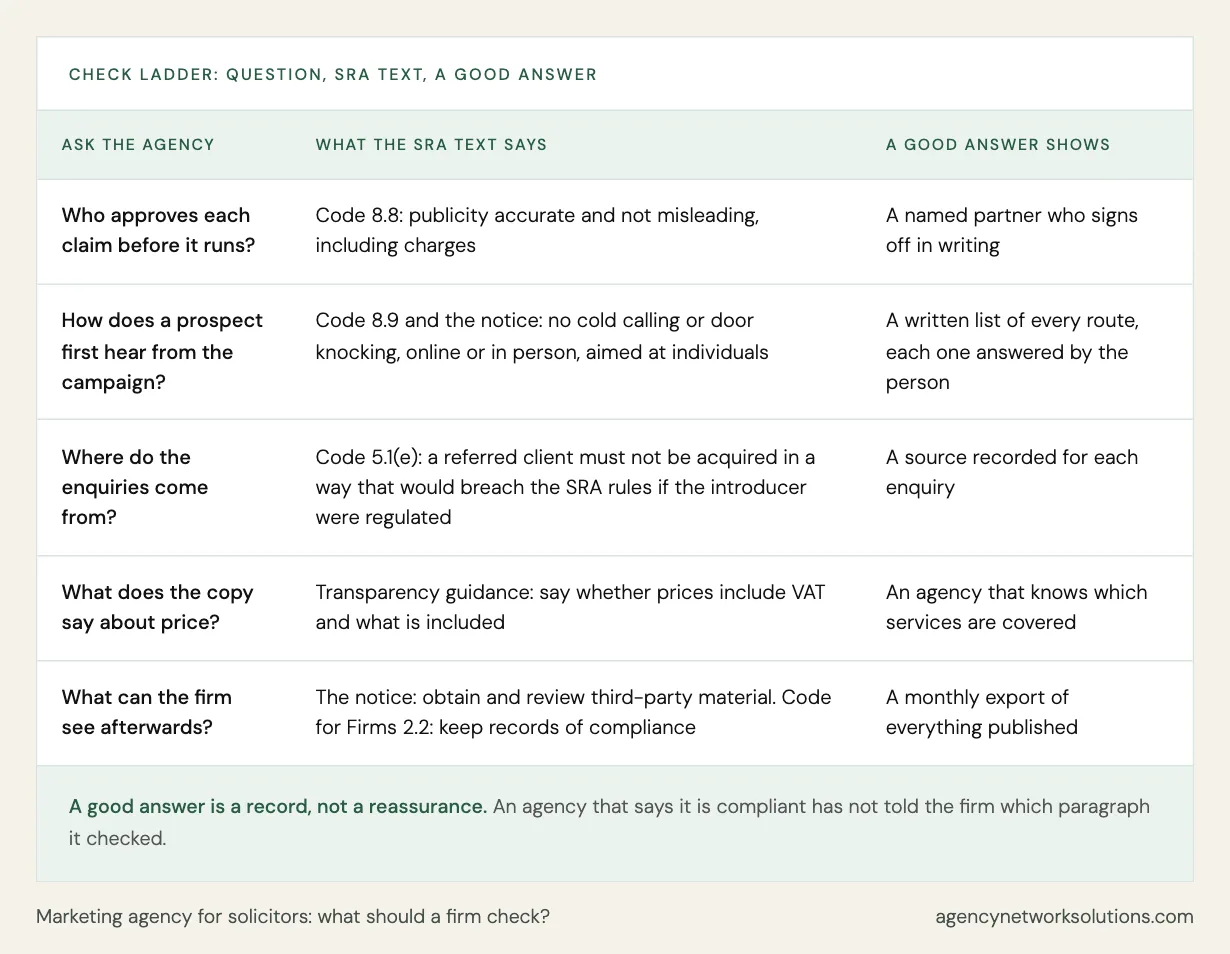
Each question below rests on a paragraph the SRA has published, and a good answer is one the firm can check against it. Three agency pages that rank for this search were opened on 11 November 2026. In the text returned, none named the Solicitors Regulation Authority or a rule, and only one quoted a figure. The ladder starts from the regulator instead.
| Ask the agency | What the SRA text says | A good answer shows |
|---|---|---|
| Who approves each claim before it runs? | Code 8.8: publicity accurate and not misleading, including charges | A named partner who signs off in writing |
| How does a prospect first hear from the campaign? | Code 8.9 and the notice: no cold calling or door knocking, online or in person, aimed at individuals | A written list of every route, each one answered by the person |
| Where do the enquiries come from? | Code 5.1(e): a referred client must not be acquired in a way that would breach the SRA rules if the introducer were regulated | A source recorded for each enquiry |
| What does the copy say about price? | Transparency guidance: say whether prices include VAT and what is included | An agency that knows which services are covered |
| What can the firm see afterwards? | The notice: obtain and review third-party material. Code for Firms 2.2: keep records of compliance | A monthly export of everything published |
The rows on approaches and sources come straight from the notice. It says a firm cannot market by unsolicited approaches, and that the ban reaches clients referred by a third party. In its words, "it is not acceptable to say that the third party was not regulated by the SRA". It also says opt-in data should be lawfully obtained and specifically cover being offered legal services, and that further approaches to someone who first enquired may still be unsolicited. Our article on client testimonials for financial advisers shows the same kind of test applied by a different regulator.
How far the warning notice reaches
The notice says it applies to law firms and the people who supervise them, particularly those doing high-volume consumer claims work. A UK firm that does conveyancing or commercial advice is not its main target, and this article does not claim otherwise. Two things still follow. The paragraphs it relies on, 8.8 and 8.9, sit in the Code that applies to the whole firm. And the notice shows how the regulator reads outsourced marketing, which is what a partner is about to sign.
The notice also covers "no win, no fee" wording. Where an advert mentions it, the notice says it should be clearly explained, including that a client may still face costs if they stop a claim or if after-the-event insurance does not respond. An agency writing for a firm that takes those cases needs to have read that part. Either way, it is a question to put in writing.
An invented screen of five proposal lines
A proposal line is worth a question when it describes a way of reaching people, a source of enquiries or a price. The five lines below are made up for this article. They describe no real agency and no real proposal, and the price is a placeholder.
| Invented line | Why it needs a question |
|---|---|
| "Our team phones homeowners who recently searched for a solicitor." | A call aimed at an individual who has not asked for one. Ask how it fits paragraph 8.9. |
| "We supply opt-in leads from our data partners." | The notice says consent must be lawfully obtained and cover legal services. Ask to see the wording shown to the person. |
| "Our adverts say no win, no fee." | The notice says the wording should explain what it means and any cost the client may still face. |
| "Fixed fee conveyancing from £600 in every advert." | The transparency guidance asks covered firms to say whether prices include VAT and what the price covers. |
| "We re-contact people who enquired but did not instruct." | The notice says a further approach to someone who first enquired may still be unsolicited. |
Set a stop line before the call: any line the agency cannot answer in writing within a week is a line the firm does not sign. That is a test of the supplier rather than of the law, and it costs a managing partner an hour. A proposal that comes back with a paragraph number against each answer is a different kind of supplier from one that comes back with a reassurance.
Questions that expose a template
A template agency answers in general terms, and a specialist answers with the firm's own services. The transparency guidance lists the services it covers: for consumers, residential conveyancing, uncontested probate, summary-only motoring offences, unfair or wrongful dismissal tribunal claims and immigration work other than asylum. It also lists business services, among them debt recovery up to £100,000. The page was updated on 30 September 2024. Ask the agency which of the firm's services sit on that list, and what it would change on the website as a result.
- Which of our services are covered by the transparency rules? A specialist can name them. A template agency will say the site will be compliant.
- Which paragraph did you check this line against? Ask it about one live sentence from the agency's own site.
- Where is the approval log kept? The firm should be able to see who approved what and when.
- Who holds the enquiry source for each client? The record is the firm's protection if the SRA asks how a client arrived.
Put the answers into the written scope, as our article on running an agency review they cannot talk through describes for the monthly meeting afterwards.
When the answers are in writing
Want a specialist who shows you every claim before it runs?
Free to your firm. The agency pays us, and only if the relationship works, so we gain nothing by recommending one who will not show you the approval log.
Get a recommendationWhen not to hire an agency yet
Do not sign while no partner will read and approve each piece of copy before it goes live. An agency cannot supply that discipline. If the partners are too busy to approve, a campaign will publish unread, and the firm learns what it said when a client or the regulator quotes it back.
Wait too if the agency will not say where its enquiries come from, or if nobody at the firm can say which of its services the price rules cover. A firm that cannot show how a client arrived has no answer to the question in the notice, and the price question is a job for the firm's compliance officer before it is a job for an agency. The wider question of whether a firm should hire at all is covered on our page for professional services firms.
Frequently asked questions
What UK law firms ask about marketing agencies.
Is a UK law firm responsible for what its marketing agency publishes?
On the text of the SRA Code of Conduct for Solicitors, publicity relating to the practice must be accurate and not misleading, and the Code for Firms applies that paragraph to firms. The SRA's warning notice on marketing to the public says the same standard covers material used by third parties. What that means for a particular arrangement is a question for the firm's compliance officer.
Does the SRA warning notice apply to a firm that does not do claims work?
The notice says it applies to law firms and individuals under their supervision, particularly those doing high-volume consumer claims work. A conveyancing or commercial firm is not its main target. The paragraphs it relies on, including 8.8 on accurate publicity and 8.9 on unsolicited approaches, sit in the Code that applies to every firm.
Can an agency cold call people on behalf of a solicitors' firm?
Paragraph 8.9 of the Code says a solicitor must not make unsolicited approaches to members of the public to advertise legal services, apart from current or former clients. The warning notice adds that the prohibition reaches clients referred by a third party, and that it is not acceptable to say the third party was not regulated by the SRA.
Do the SRA transparency rules affect what a marketing agency writes?
They can. The SRA's guidance says covered firms must say whether stated prices include VAT and exactly what the price includes, in a prominent place on the website. The rules cover listed services such as residential conveyancing and uncontested probate, so ask the agency which of the firm's services are covered.
When should a solicitors' firm not hire a marketing agency yet?
When no partner will read and approve each piece of copy before it goes live, or when the agency will not say where its enquiries come from. A firm that cannot see the source of an enquiry cannot show the SRA how the client was acquired.
Sources and useful reading
Four pages on sra.org.uk were opened and read on 11 November 2026 for this article. No agency price page was relied on and the proposal lines and price in the screen are invented.
- SRA: Marketing your services to members of the public, warning notice, published 19 December 2024, for scope, unsolicited approaches, introducers, opt-in data, no win no fee wording and third-party material.
- SRA: Code of Conduct for Solicitors, RELs, RFLs and RSLs, for paragraphs 5.1, 8.8 and 8.9.
- SRA: Code of Conduct for Firms, for paragraphs 2.2 and 8.1.
- SRA: Transparency in price and service, updated 30 September 2024, for the covered services and the VAT rule.
This article is commercial decision support and is not legal advice. The SRA amends its rules and guidance from time to time, so check the current text and ask the firm's compliance officer before relying on any reading here. It does not cover the Advertising Standards Authority or data protection law. The proposal lines and price are invented to show the method and describe no real agency.