
The short answer
A UK solicitors' firm may publish results and client reviews, but the Solicitors Regulation Authority expects each to be accurate and not misleading, and the Competition and Markets Authority treats fake reviews and a favourable-only selection as misleading. Before a headline or review wall goes live, a partner should check that each figure traces to a matter and that any reward behind a review is disclosed.
Key takeaways
- Paragraph 8.8 of the SRA Code of Conduct for Solicitors says publicity must be accurate and not misleading, and the Code for Firms applies that standard to the firm.
- The SRA's December 2024 notice names four things publicity must not mislead about: prospects of success, the level of any award, other claimants' feedback and awards or credentials.
- Its January 2026 notice tells firms in high-volume consumer claims work to avoid testimonials that could create unrealistic expectations.
- The CMA's guidance of 4 April 2025 says suppressing genuine negative reviews or hiding an incentive can be misleading.
- The review wall and every figure in the worked example are invented. Seven pages were opened and no agency, firm or client is named.
Four. That is the number of things the Solicitors Regulation Authority's December 2024 warning notice says a firm's publicity must not mislead about: the prospects of success of a claim, the level of any award, feedback provided by other claimants and awards or credentials. The notice was written for firms doing high-volume consumer claims work, and a UK conveyancing or commercial practice is not its main target. The four items still describe what a results headline and a review wall do: they tell a stranger what to expect and who else was satisfied. A managing partner who signs off an agency's copy is signing off those four, and the usual marketing guidance never mentions them.
What the SRA text says about results and testimonials
The SRA puts the duty on the firm's publicity, and it does not carve out what a supplier writes. Paragraph 8.8 of the Code of Conduct for Solicitors says a solicitor ensures that any publicity in relation to their practice is accurate and not misleading, including that relating to charges. The Code of Conduct for Firms applies the publicity paragraphs, 8.6 to 8.11, to firms through paragraph 7.1(c), and paragraph 8.1 makes a manager responsible for the firm's compliance with that Code. The practical effect for a UK partner is that an agency-written headline is the partner's headline.
The warning notice on marketing to members of the public, published on 19 December 2024, is the source of the four-item list. It adds that a firm should regularly obtain and review any publicity used by third parties it is engaged with. The separate notice on "no win, no fee" in high-volume consumer claims, published on 28 January 2026, goes further on testimonials. It says firms must avoid language or testimonials that could create unrealistic expectations about the likelihood of success, the speed and simplicity of the process, or the financial risks or benefits. Both notices state their scope, and this article does not stretch it: they are aimed at claims work. They also show how the regulator reads a testimonial, which is as a statement about what the next client can expect.
A four-line test for any results or review claim
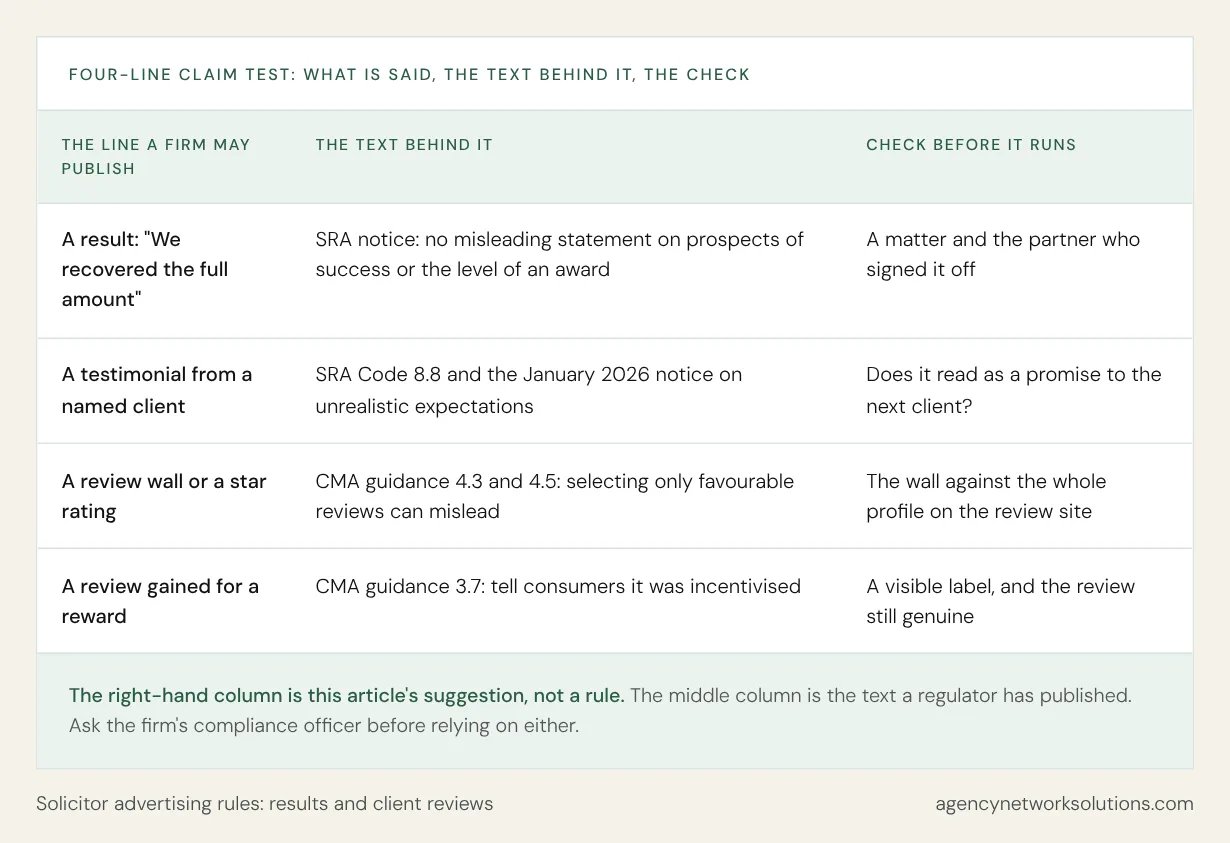
Each line a firm might publish about its record has a sourced reason to be checked and a question that settles it. The test below keeps the SRA text, the CMA text and the proposed check apart, so a partner can see which part is a rule and which is this article's suggestion.
| The line a firm may publish | The text behind it | Check before it runs |
|---|---|---|
| A result: "We recovered the full amount" | SRA notice: no misleading statement on prospects of success or the level of an award | A matter and the partner who signed it off |
| A testimonial from a named client | SRA Code 8.8 and the January 2026 notice on unrealistic expectations | Does it read as a promise to the next client? |
| A review wall or a star rating | CMA guidance 4.3 and 4.5: selecting only favourable reviews can mislead | The wall against the whole profile on the review site |
| A review gained for a reward | CMA guidance 3.7: tell consumers it was incentivised | A visible label, and the review still genuine |
The first row is the one agencies get wrong most easily, because a result is a good headline and a bad generalisation. A figure from one matter is a statement about that matter. Put the matter and the partner beside it in the file, or leave it off the page.
What the SRA says about engaging with reviews
The SRA wants firms to engage with online reviews, and it sets limits on how. Its customer reviews guidance encourages firms to publish information about service quality, including reviews, and says doing so should help a firm win more business. The page on engaging with online reviews suggests asking clients to leave a review, for example with a link to a review site, and replying professionally to all negative reviews without getting personal or defensive.
It also sets two limits. A reply must not reveal confidential or privileged information about a client, even to correct the record. And the SRA says firms should not pressure clients to withdraw a negative review, or pressure a review site to remove one. For a review the firm believes is fake, it suggests first checking whether it is genuine, usually by contacting the site, and replying neutrally that the firm has been unable to verify it. An agency running a firm's review replies needs those limits in writing. Our article on whether an agency should run your firm's LinkedIn presence makes the same point about any account where the agency speaks as the firm.
What the CMA adds about fake and selective reviews
The CMA's guidance of 4 April 2025 treats the selection of reviews as part of the offence, not only the writing of them. Its fake reviews guidance explains the ban in the Digital Markets, Competition and Consumers Act 2024 on fake reviews and concealed incentivised reviews, and on publishing reviews in a misleading way. It is addressed to traders and to the sites that publish consumer reviews, and whether a given firm's service falls inside it is a question for the firm's compliance officer. Two of its passages bear on a law firm's page.
- Paragraph 3.7 says a trader may reward customers for reviews, but must tell consumers the review was incentivised, and the review must still reflect the reviewer's genuine experience.
- Paragraphs 4.3 to 4.5 say a trader may infringe the law by suppressing genuine reviews or selectively promoting positive or negative ones. They list selecting only favourable reviews, or encouraging only satisfied customers to review, as cherry picking, and they say traders should not discourage negative reviews through threats of harm or legal action.
The point on threats sits close to the SRA's line on pressure, and the two together are the reason a firm's review policy should be written before a campaign starts rather than after the first one-star review lands.
An invented review wall, worked through
The gap between the reviews a firm has and the reviews it shows is arithmetic a partner can do in five minutes. The numbers below are made up for this article. They describe no real firm and no real site.
| Measure | On the review site | On the website wall |
|---|---|---|
| Reviews counted | 40 | 8 |
| Five-star reviews | 34 (85%) | 8 (100%) |
| Four-star and one-star | 4 and 2 | None |
| Average, with the sum shown | (34 x 5 + 4 x 4 + 2 x 1) / 40 = 4.7 | 5.0 |
| Gained through a prize draw | Invented: 9 of the 34 | Invented: 3 of the 8, no label |
Read against the CMA's paragraphs, the wall has two problems and one question. Selecting eight favourable reviews from forty is the pattern paragraph 4.5 describes. Three of the eight were gained through the invented prize draw with no label, which is the situation paragraph 3.7 covers. The question is whether the firm asked everyone or only the happy ones. If it asked only the satisfied, paragraph 4.5 names that too.
The fix is cheap. Show the profile's own rating and count with a link to the full page, and label the rewarded reviews. A wall built that way looks less perfect and reads as more credible to a sceptical client, which suits a regulated practice better than a row of identical five-star quotes.
When the claims are on file
Want a specialist who shows you every claim before it runs?
Free to your firm. The agency pays us, and only if the relationship works, so we gain nothing by recommending one who will not show you where each figure came from.
Get a recommendationFour questions to put to the agency in writing
An agency that writes about results and reviews should be able to answer four questions in a paragraph each. Add them to the scope of work, alongside the checks in our article on what a solicitors' firm should check before hiring a marketing agency.
- Where does every result figure come from? A good answer names the matter and the partner who approved it.
- Who chooses which reviews are displayed? The answer should be a rule, such as the profile's own rating, and not a person's taste.
- Was any review rewarded, and where is that shown? The CMA expects the label, so ask to see it on the page.
- What happens when a review is negative? The agency should say it will not ask a client to take it down, and that no reply will carry client detail.
An audit of what is already published is a sensible first job, and our article on whether a paid audit is worth it before replacing an agency sets out when one pays for itself.
When not to publish the claim yet
Hold a results headline or a review wall until a partner has the paper behind it. If nobody can trace a figure to a matter, the line is not accurate, whatever the agency calls it. If the firm has not decided who answers a negative review, a first complaint will be answered by whoever has the login.
A firm in high-volume consumer claims work should read the two SRA notices in full before an agency writes a word, because they were written for exactly that work. For any other firm, none of this needs a campaign to wait for months. It needs one partner and a file. The wider question of what suits a firm in your position is on our page for professional services firms.
Frequently asked questions
What UK law firms ask about results and reviews.
Can a UK law firm publish client testimonials on its website?
The SRA pages opened for this article neither require nor ban them. Its customer reviews guidance encourages firms to publish information about service quality, and its Code says publicity must be accurate and not misleading. For firms doing high-volume consumer claims work, the SRA's January 2026 notice says to avoid testimonials that could create unrealistic expectations about the likelihood of success. The firm's compliance officer decides what that means for a given page.
Can a solicitors' firm ask its clients to leave a review?
The SRA's online reviews guidance suggests asking clients to leave reviews, for example by sharing a link to a review site. The CMA's guidance says that emailing customers generally to ask whether they wish to review, without predetermining the content or sentiment, is not prohibited. If the firm offers a reward, the CMA says the review must say so and still reflect the reviewer's genuine experience.
Can a firm reply to a negative review?
Yes. The SRA says it is acceptable to respond to a review left by a current or former client, but a reply must not reveal confidential or privileged information. The SRA also says firms should not pressure clients to withdraw a negative review, or pressure a review site to remove one.
Does the CMA's fake reviews guidance apply to a law firm?
The guidance is addressed to traders who publish consumer reviews and to the sites that host them. Whether a particular firm's service falls within it is a question for the firm's compliance officer or its own adviser. The sensible reading for a managing partner is that the CMA's examples show the sort of review page a UK regulator treats as misleading.
When should a firm hold back a results headline?
When no partner can trace the figure to specific matters and a date, or when the line states a likely outcome for the next client instead of a past one. Those are tests this article proposes and not an SRA rule. The SRA text asks that publicity be accurate and not misleading, and a figure nobody can trace is not accurate.
Sources and useful reading
Seven pages were opened and read on 12 November 2026 for this article. The review wall, its counts, its star ratings and the prize draw are invented.
- SRA: Marketing your services to members of the public, warning notice, published 19 December 2024, for the four-item list, scope and third-party material.
- SRA: warning notice on "no win, no fee" in high-volume consumer claims, published 28 January 2026, for the line on testimonials.
- SRA: Code of Conduct for Solicitors, RELs, RFLs and RSLs, for paragraphs 1.4 and 8.8.
- SRA: Code of Conduct for Firms, for paragraphs 7.1(c) and 8.1.
- SRA: customer reviews, for the encouragement to publish.
- SRA: Online reviews, how to engage with them, for replies, pressure and fake reviews.
- CMA: Fake reviews guidance (CMA208), 4 April 2025, for paragraphs 3.7 and 4.3 to 4.5.
This article is commercial decision support and is not legal advice. The SRA and the CMA amend their guidance from time to time, so check the current text and ask the firm's compliance officer before relying on any reading here. It does not cover the Advertising Standards Authority or data protection law. The review wall and its figures are invented to show the method and describe no real firm.