
The short answer
A UK recruitment agency should build lead generation when a partner will own the outreach for two quarters, and buy it when hirer meetings are needed sooner than a hire could produce them. Either way the agency stays answerable under the Privacy and Electronic Communications Regulations, so the choice turns on who holds the records. Measure signed hirers, not meetings.
Key takeaways
- Regulation 21 of the Privacy and Electronic Communications Regulations 2003 covers instigating an unsolicited marketing call as well as making one.
- A caller must not block the calling line identity, or must show a line where it can be contacted.
- Unsolicited email to individual subscribers needs consent or the soft opt-in, and the regulations define corporate subscribers separately.
- Two routes that cost almost the same per meeting can differ in cost per signed hirer, so count signings.
- Every cost in the worksheet is invented. No supplier price page was opened.
The usual advice treats build or buy as a cost question: a salaried hire on one side, a supplier's monthly fee on the other. The assumption behind it is that buying outreach also buys the rulebook, so that whatever the supplier does on the telephone becomes the supplier's concern. For a UK recruitment agency that assumption is wrong on the text of the regulations. A managing partner who signs a lead generation contract can still be the person the rules reach. The decision is better made on what each route leaves the agency holding when the work stops.
What each route leaves the agency holding
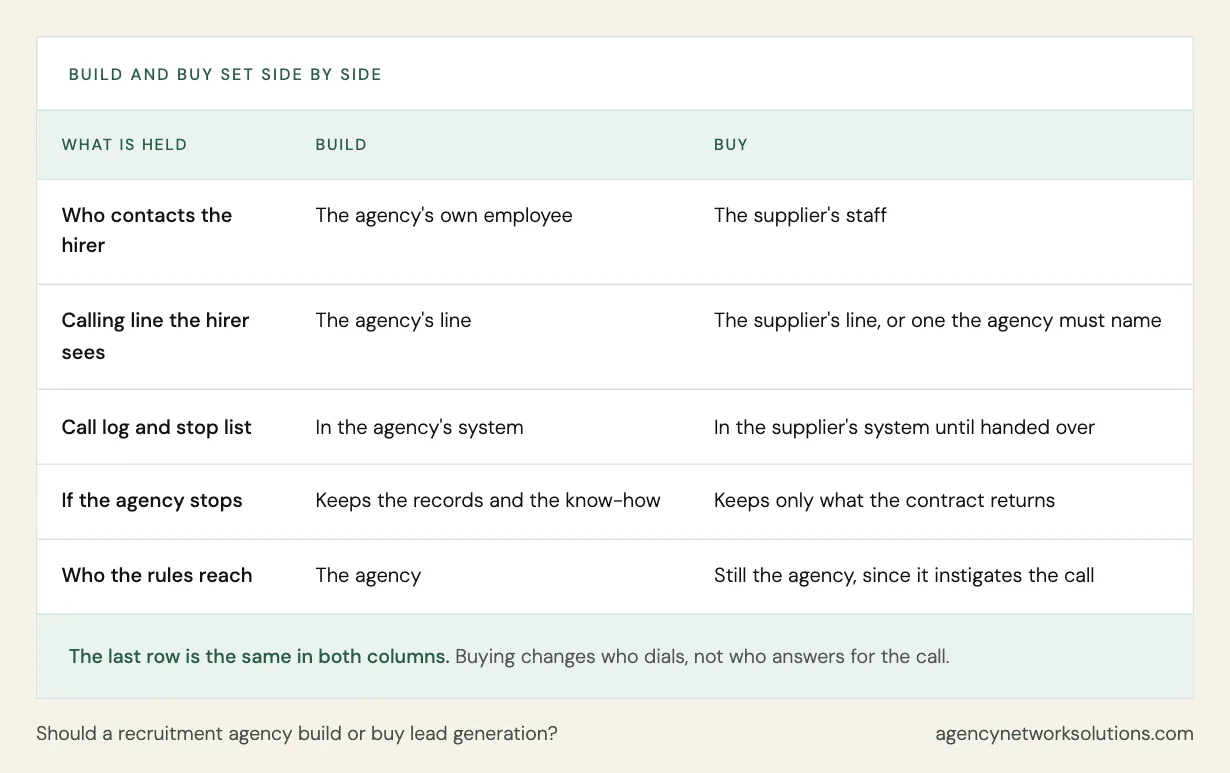
Building keeps the records and the calling line in the agency, and buying puts both in someone else's system unless the contract says otherwise. Two pages that rank for this question were opened for this piece. One is a vendor comparison with dollar salaries and no source for any figure, and the other is a supplier's service page with unsourced results. Neither mentions a UK rule. The matrix below starts from what the agency holds instead.
| What is held | Build | Buy |
|---|---|---|
| Who contacts the hirer | The agency's own employee | The supplier's staff |
| Calling line the hirer sees | The agency's line | The supplier's line, or one the agency must name |
| Call log and stop list | In the agency's system | In the supplier's system until handed over |
| If the agency stops | Keeps the records and the know-how | Keeps only what the contract returns |
| Who the rules reach | The agency | Still the agency, since it instigates the call |
A recruitment agency that has already tried outreach will find the routes compared in our article on how recruitment agencies get clients. Search is one of them, and whether SEO works for a recruitment agency tests that route alone. This article is about the outreach route, where the rules bite hardest.
The calling and email rules do not change hands
Regulation 21 bars unsolicited direct marketing calls to a line whose subscriber has said such calls should not be made, or whose number is on the register kept under regulation 26. The text is on legislation.gov.uk. A caller is not treated as in breach if the number had been listed for less than 28 days. A subscriber on the register can still tell a particular caller that they do not object, and can withdraw that permission. Regulation 21 also says a caller must not prevent the calling line identity being shown, or must present a line on which it can be contacted.
The prohibition covers a person who instigates the use of the service for such a call, not only one who dials. That is a reading of the text and not legal advice. It is why the last row of the matrix is the same in both columns, and why the agency's compliance contact should see any supplier's call script before it is used. Our article on how financial advisers get clients without cold calling covers the same rule from another sector.
Email is different. Regulation 22 applies to unsolicited email to individual subscribers. It requires consent unless the soft opt-in conditions are met: contact details obtained in the course of a sale or negotiations for one, marketing of the sender's own similar services, and a simple means of refusing. Regulation 2 defines an individual as a living individual that includes an unincorporated body of such individuals, and lists corporate subscribers separately, including companies and partnerships in Scotland. Which kind of subscriber a given hirer is cannot be settled by assuming it, so it goes to the compliance contact. This article does not cover UK GDPR or LinkedIn messages, and it does not say how the register treats corporate lines.
A year of cost, invented, read per signed hirer
Two routes can cost almost the same per meeting and still differ by a sixth per signed hirer. No supplier price page was opened for this article and no benchmark was found that could be checked, so the worksheet is made up and describes no real agency or supplier. It shows how to read the numbers once they are the agency's own.
| Route | Twelve month cost | Hirer meetings | Signed hirers | Per meeting | Per signed hirer |
|---|---|---|---|---|---|
| Build: one hire and tools | £51,000 | 40 | 8 | £1,275 | £6,375 |
| Buy: a monthly fee of £2,500 | £30,000 | 24 | 4 | £1,250 | £7,500 |
The arithmetic: £51,000 over 40 meetings is £1,275, and over eight signings £6,375. £30,000 over 24 meetings is £1,250, and over four signings £7,500. The build route signs one hirer in five meetings and the buy route one in six. A supplier's report of meetings booked would have made the two look level, which is how a comparison on meetings misleads.
What would flip it? If the bought meetings had signed at the build rate, 24 meetings would give about five signings, and £30,000 over five is £6,000, which beats £6,375. One extra signing reverses the order. That is why the stop line matters more than the monthly fee: before the first month, write down what would end the test, for example fewer than two signed hirers by month six. The same count suits the recruitment agencies we introduce specialists for whichever route they choose.
Four checks before signing a bought contract
Each check turns a vague promise into something the agency can inspect. Take them to the supplier in writing, and to the compliance contact at the same time.
- Whose line and whose name. Which calling line will hirers see, and can a hirer reach the agency on it? Regulation 21 requires a caller not to block the identity or to show a contactable line.
- Whose records. Who holds the call log and the stop list, and when are they handed over? A stop list kept only by the supplier leaves the agency unable to prove who asked not to be called.
- Which register check. Who checks numbers against the register kept under regulation 26, and how recently? The 28 day rule means a check made last month proves less than one made last week.
- Which count. Does the supplier report signed hirers by source, or only meetings booked? The worksheet shows why the first is the one that pays the fee.
The wording of what the agency can ask for afterwards belongs in the contract, as our article on what to reclaim when an agency engagement ends sets out.
Reading the count at month six
The stop line is applied to signed hirers, and a partner applies it, not the person running the outreach. Take the invented figures again. By month six the build route has about four signings and the buy route about two, so both clear a line of fewer than two. The line does not say which route is better. It says neither has failed, and the full twelve months then decide the order.
Suppose instead the bought route showed one signing at month six. Under the line it stops, and the agency has paid roughly £15,000 for one hirer. That is a poorer result than the full-year figure suggests, and also a cheaper way to learn it than finishing a contract. A short bought test with a written stop line is the one case where buying clearly protects the agency, because the exit is agreed before the first call is made.
For a built route the same line applies, with one addition. The hire's first months are mostly learning the specialism, so the partner should expect meetings to arrive later than they would from a supplier that already dials. The line is the same, but the agency should be honest about when it starts counting.
When the count is agreed
Want a specialist who reports signed hirers, not meetings?
Free to your firm. The agency pays us, and only if the relationship works, so we gain nothing by recommending one who cannot show you the count.
Get a recommendationWhen not to buy, and when not to build
Do not buy if no partner will read the call log every month. A bought route without review is the one most likely to produce meetings that do not sign, and the agency would only see it a year later. Do not buy either if the supplier will not name the calling line or hand the stop list back at the end.
Do not build if no partner will own the outreach for two quarters. A hire left alone with no one to review the count tends to drift into activity that cannot be tested. If hirers are needed this quarter and the agency has nobody to start, buy a short test with a written stop line and hand the work back when it ends.
Frequently asked questions
What UK recruitment agencies ask about lead generation.
Is it cheaper for a UK recruitment agency to build or buy lead generation?
No independent figure was found for this piece, so the answer depends on the agency's own numbers. In the invented worksheet above, the two routes cost almost the same per meeting and differ by about a sixth per signed hirer. Compare cost per signed hirer over twelve months, not the monthly fee against a salary.
Does buying lead generation make the supplier responsible for the calling rules?
Not on the text of the regulation. Regulation 21 of the Privacy and Electronic Communications Regulations 2003 covers instigating a call as well as making one, so an agency that has a supplier phone hirers for it stays in the picture. What that means for a particular arrangement is a question for the agency's compliance contact.
Can a recruitment agency email hirers without consent?
Regulation 22 applies to unsolicited email to individual subscribers and requires consent unless the soft opt-in conditions are met. The regulations define corporate subscribers separately, so which rule a given hirer falls under depends on the kind of subscriber. This article does not cover UK GDPR, which a compliance contact should also check.
What should a recruitment agency keep if it ends a bought lead generation contract?
It should ask for the call log and the stop list, since both show who was contacted and who asked not to be. Agree this in writing before the contract starts, because a supplier has little reason to hand records over afterwards.
How long should a UK recruitment agency test lead generation before deciding?
Set the stop line before the first month. The worksheet uses fewer than two signed hirers by month six as an invented example. Pick a line that suits the agency's average fee and sales cycle, and write it down with the date.
Sources and useful reading
Three pages of the Privacy and Electronic Communications Regulations 2003 were opened and read on 10 November 2026 for this article. No supplier price page was opened and every figure in the worksheet is invented.
- legislation.gov.uk: regulation 21, for the rule on unsolicited marketing calls and the calling line identity.
- legislation.gov.uk: regulation 22, for the rule on unsolicited email to individual subscribers and the soft opt-in.
- legislation.gov.uk: regulation 2, for the definitions of an individual and a corporate subscriber.
This article is commercial decision support and is not legal advice. The regulations are amended from time to time, so check the current text and ask the agency's compliance contact before relying on any reading here. The worksheet and its figures are invented to show the method and describe no real agency or supplier.